
Engine Oil Manufacturers in India: Quality Standards Every Buyer Should Know
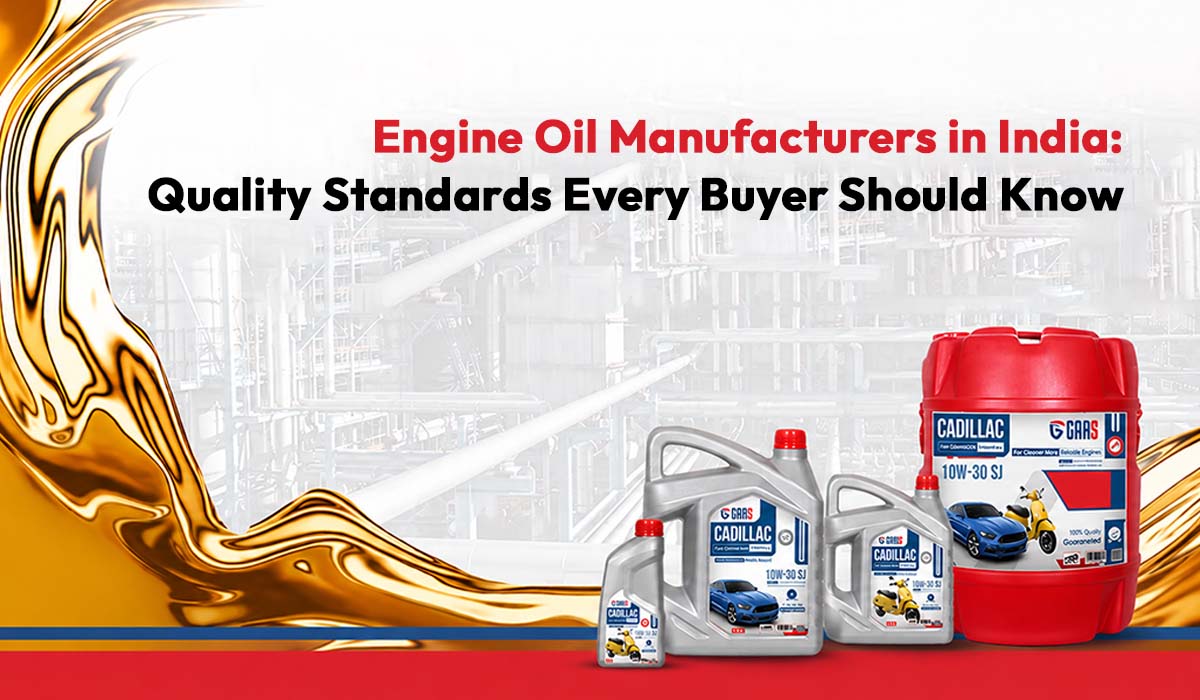
Engine Oil Manufacturers in India: Quality Standards Every Buyer Should Know
Engine Oil Manufacturers in India: The Questions Every Buyer Should Be Asking
Walk into any auto parts market in India, and you will find engine oil from dozens of brands stacked on the same shelf. Some are manufactured under strict quality controls with certified formulations. Others are blended with cheaper raw materials and sold on price alone. From the outside, the bottles look similar. Inside, an engine runs on them for 50,000 kilometres; the difference is impossible to ignore.For anyone sourcing from engine oil manufacturers in India - whether you are building a distribution network, supplying a fleet, or stocking a retail outlet - understanding what actually separates the gap between a quality manufacturer and a cheap one rarely shows up on the invoice; it shows up six months later in a customer's engine, and by then the damage is already done.
This guide covers the quality standards, certifications, raw materials, and manufacturing processes worth understanding before committing to a supply relationship.
What Engine Oil Manufacturers in India Actually Do
There is an important distinction that buyers often miss - the difference between a manufacturer and a trading company. A manufacturer controls the production process from start to finish. Raw material sourcing, formula development, blending, testing, packaging, dispatch - all of it happens under one roof with direct quality oversight. A trading company sources finished product from elsewhere, repackages it, and sells it on. The quality control of a trading company extends only as far as what it buys - not how it is made.Genuine engine oil manufacturers in India serve a wide range of markets - passenger vehicle workshops, two-wheeler service networks, commercial fleets, industrial machinery users, and international export buyers. The ability to serve all of those consistently, across multiple grades and formats, reflects real manufacturing depth rather than a catalogue built on sourced product.
When a manufacturer controls the production process, every batch that leaves the facility is the result of the same raw materials, the same formula, and the same testing. That consistency is what buyers are actually paying for - and what is missing when it breaks down.
Not Sure How Often Your Engine Needs an Oil Change?
Why Quality Standards in Engine Oil are Not Just a Compliance Exercise
Poor quality engine oil does not announce itself. It is not the kind of damage that announces itself. Bearings wear a little more each service. Oil passages narrow as sludge settles in. Fuel consumption nudges upward week by week. Nobody connects it back to the oil until the repair bill arrives. By the time the problem becomes obvious, the cost of fixing it is well past what any savings on the original oil purchase could justify.Quality standards exist to prevent exactly that from happening:
- Engine Protection - properly formulated oil holds a protective film between metal surfaces even when temperatures climb and loads get heavy
- Performance Consistency - standardised production means the oil behaves the same way on the fiftieth batch as it did on the first
- Longer Engine Life - oil that maintains its properties across the full service interval protects against the gradual wear that shortens engine life
- Fuel Efficiency - oil viscosity that matches the engine specification reduces internal friction and the energy wasted overcoming it
- Lower Maintenance Costs - cleaner engines, longer drain intervals, and fewer breakdowns all reduce what it costs to keep a vehicle running
Key Standards Every Credible Engine Oil Manufacturer Should Meet
API Standards
Most buyers have heard of API certification. Fewer know what it actually confirms - or how easy it is for manufacturers who cannot genuinely earn it to claim it anyway. API certification means the oil went through independent performance testing against defined benchmarks. It is not a self-declaration. It is not a label a manufacturer can print because their formula looks close enough on paper. Any engine oil manufacturer who hesitates when asked for current API documentation, or produces paperwork that does not hold up to scrutiny, is telling you something important about the product behind the label.SAE Viscosity Grades :
The numbers on an engine oil bottle are not marketing - they are a performance specification. 5W30 tells you the oil will flow freely from a cold engine and hold its body once the engine reaches operating temperature. 10W40 and 15W40 work differently across that same range. A manufacturer who hits those viscosity targets accurately and consistently gives buyers oil that behaves the same way in every engine it goes into. One who does not - whether through inconsistent blending or cost-cutting on base oil quality - creates variation that does not show up on the invoice but does show up inside customer engines over time.ISO Certified Manufacturing :
ISO 9001 is not a product certification - people sometimes confuse the two. It does not tell you the oil is good. What it tells you is that the facility producing it runs a documented quality management system with defined procedures, regular audits, and controls built into every stage of production rather than bolted on at the end. For buyers comparing engine oil wholesale suppliers, ISO certification is one of the more reliable signals that the manufacturer treats quality as a production discipline - not something they think about when a customer asks.Quality Testing at Every Stage :
A manufacturer who only tests at the end of the production process is catching problems after they have already happened. Serious manufacturers test throughout:- Raw materials tested before they enter production
- Each batch tested during and after blending
- Each batch checked for how it flows, how it behaves under heat, how long it resists breaking down, and how well it protects metal surfaces under load.
- Final inspection before packaging and dispatch
The Raw Materials That Determine What Ends Up in Your Engine
The quality of the finished engine oil is set long before the bottle is filled - it is determined by the raw materials that go into the blend.Base Oils :
Base oil is the foundation everything else is built on. Mineral, semi-synthetic, or fully synthetic - the quality and grade of the base oil determines the oil's fundamental thermal resistance, viscosity stability, and how long it holds its properties in service. Cheaper base oils produce cheaper finished products, regardless of what the additive package on top of it does.Additive Packages :
Additives are what turn base oil into engine oil. The balance and quality of the additive package determines wear protection, oxidation resistance, corrosion inhibition, and deposit control. This is where formulation expertise separates manufacturers who understand what goes into a well-performing oil from those who are hitting a price point.Anti-Wear Additives :
Under high load, metal surfaces inside the engine come close enough to contact that only the additive film stands between them. Anti-wear additives form that film - and the quality of those additives under real operating conditions is one of the clearest differentiators between a well-formulated oil and a cheap one.Oxidation Inhibitors :
Heat oxidises engine oil over time - breaking it down into acids and deposits. Oxidation inhibitors slow that process. Oil with a weak inhibitor package degrades faster, shortens service intervals, and leaves more deposits behind in the engine.Detergents and Dispersants :
These keep the combustion byproducts and contaminants that accumulate during normal engine operation suspended in the oil rather than settling on surfaces as sludge. A strong detergent and dispersant package keeps the engine cleaner between services - a weak one lets sludge build up in places that are expensive to clean or replace.What a Proper Manufacturing Process Looks Like
When a buyer visits or audits a manufacturer, this is the process they should be looking for: Raw Material Selection : Verified suppliers, incoming quality checks, and documented approval before any material enters production. Formula Development : Each product built around defined performance targets - not minimum compliance with the cheapest specification available. Precision Blending : Getting the ratio of base oil to additives right is not something you can eyeball. Our blending equipment is calibrated specifically to hold those ratios consistent - because even small variation at this stage creates batch-to-batch differences that buyers eventually notice in the field. Laboratory Testing : Before any batch moves to the filling line, it goes through the lab. Viscosity, flash point, oxidation stability, wear protection - each one checked against the target specification. If something does not sit where it should, the batch does not move forward. Quality Inspection : Once blending and testing are done, finished product is checked against the batch record before it goes anywhere near a packaging line. This is not a formality - it is the point where anything that slipped through earlier gets caught. Filling and Packaging : The right volume goes into the right container with labelling that accurately reflects what is inside. Grade, certification, volume - all of it checked before the product is sealed. Final Dispatch : Nothing that has not cleared every prior stage leaves the facility. That is not a policy statement - it is how the production floor actually runs.What Reliable Engine Oil Manufacturers in India Look Like Up Close
Evaluating bike engine oil companies in India or any engine oil manufacturer for a long-term arrangement is easier when you know what you are actually looking for. The ones worth working with tend to show the same things when you look closely:- Blending and filling equipment that is maintained and updated - not running on machinery from a decade ago that nobody has serviced
- A laboratory that runs tests on every batch in-house rather than sending samples out periodically and hoping for the best
- A technical team who built the formulations and can have a detailed conversation about them without consulting someone else
- Quality documentation that comes out of a filing system - not something that gets put together when a buyer asks for it
- A production setup that can fill large repeat orders without the supplier needing to delay, substitute, or come back asking for more time
- Someone on the technical side who is still reachable six months after the first order shipped
Mistakes Buyers Make That Show Up Later
Letting price drive the whole decision : The cheapest product on the market did not get there by accident. Something in the production chain - raw material grade, additive package depth, testing frequency - has been reduced to hit that number. The saving on the invoice ends up sitting inside customer engines as wear and deposits. Not bothering with certification checks : A product without API certification has not been independently tested. The manufacturer's own claims are all that backs it up. In a market the size of India's where product quality varies enormously, that gap matters more than buyers assume until they have a problem. Assuming production capacity is not worth asking about : A manufacturer who cannot consistently fill large repeat orders is a risk that does not show up on the first delivery. It shows up on the third or fourth - usually when a distributor has already committed to customers who are now waiting. Taking quality control at the manufacturer's word : Ask to see test documentation. Ask what gets tested, at which stage, and by whom. A manufacturer with real quality control produces that paperwork without hesitation. One who cannot is telling you something important about what actually happens on their production floor. Not thinking about what comes after the purchase : Grade selection, compatibility questions, application advice - these come up after the order is placed, not before it. A manufacturer whose technical team disappears after the invoice is paid leaves buyers sorting those questions out alone.Why the Quality Decision Matters More Than the Price Decision
Buyers who go on price alone tend to feel the real cost within a few reorder cycles - sometimes sooner:- Batches that vary from one delivery to the next create unpredictable results in end-user engines - and the complaints land with the distributor, not the manufacturer
- Oil that does not hold up across the full service interval it was sold on pushes maintenance frequency higher for workshops and fleets
- Customers who have a bad experience with a product stop ordering it - and they tell others
- Returns and complaints absorb the margin that made the lower price look attractive in the first place
- The distributor or retailer takes the reputation hit for a quality problem they did not create
How GARS Lubricants Runs Its Manufacturing
GARS Lubricants manufactures engine oils, gear oils, hydraulic oils, greases, and specialty lubricants from a production facility in Surat, Gujarat - supplying domestic distributors and international export buyers across a full grade range.Every production batch is tested in the in-house laboratory before it leaves the facility. The technical team behind the formulations is the same team that answers buyer questions about grade selection and application - there is no gap between the people who made the product and the people who support it after purchase.
Quality control runs at every stage - raw material intake, blending, post-production testing, and final inspection before packaging. Distributors and wholesale buyers sourcing from a single lubricant engine oil manufacturer get a complete portfolio with production standards that are documented, applied consistently, and not adjusted based on who is watching.
Conclusion
Price is easy to compare. What is harder to see - until it shows up in a customer's engine or a distributor's returns pile - is what the manufacturing process behind a product actually looks like.The engine oil manufacturers in India worth building a supply relationship with are the ones whose API certifications are current, whose batch testing is documented, whose production capacity matches their promises, and whose quality on the hundredth order matches what arrived on the first.
For buyers who want a manufacturer that treats production quality as the operating standard rather than the sales pitch, the Gars Lubricants engine oil range is worth a closer look at garslubricants.com.
FAQ's
What are the most important quality standards for engine oil?
API and SAE are the two that matter most in practice. API tells you the oil was independently tested - not just formulated to look good on a data sheet. SAE tells you it flows correctly when the engine is cold and holds up once it is running hot. ISO 9001 sits behind both of those - it confirms the facility producing the oil runs a documented, audited production process rather than hoping things come out right.Why does API certification matter when choosing an engine oil manufacturer?
Because without it, the only thing backing the performance claim is what the manufacturer says about their own product. API certification means an independent body tested the oil against defined benchmarks and confirmed it passed. That distinction matters when you are deciding which oil goes into customer engines.How do serious manufacturers test engine oil quality?
The ones worth working with test throughout the production process - not just at the end of it. Raw materials are checked before they enter production. Each batch is tested during and after blending. Finished product is inspected before it reaches packaging. A manufacturer who only runs checks at the final stage is finding problems after they have already made it into the product.Mineral oil or synthetic - what actually changes in the engine?
Mineral oil is refined from crude and handles everyday driving in standard conditions. Synthetic is engineered specifically for heat resistance and longer service life. Semi-synthetic sits in the middle - a practical blend that outperforms mineral without the full synthetic price.What should I actually check before committing to an engine oil manufacturer in India?
Get their API certification and batch test reports in hand before anything else. Check their production capacity against your actual order volumes. Then talk to their technical team - not their sales team. That conversation tells you far more about the manufacturer than any brochure does.Which certifications matter most when sourcing from an engine oil manufacturer?
API for performance, SAE for viscosity grading, ISO 9001 for the production process. Any OEM approvals on top of those are a bonus - they mean vehicle manufacturers have independently validated the product against their own engine specifications.Does it really matter how the oil is manufactured?
It shows up eventually - just not immediately. Inconsistent blending, weak base oils, or an off-balance additive package all degrade faster under heat and load. The engine does not flag it straight away. The damage builds quietly and turns up in the workshop later.Why does getting the viscosity grade wrong cause problems?
Too thin at running temperature and the protective film breaks down. Too thick at cold startup and the oil takes too long to reach the parts that need it. Either way the engine pays for it - the right SAE grade is what keeps both ends of that range covered.Can Indian manufacturers supply engine oil in bulk for export?
Yes - most established manufacturers handle international bulk orders regularly. Pin down the minimum quantities, packaging formats, lead times, and export documentation before you commit. Do not rely on what the sales material says - ask directly and get it confirmed.What separates reliable bike engine oil companies in India from the rest?
The ones worth working with test every batch, hold current API certification, and source consistent raw materials. The difference between them and cheaper alternatives does not show up in the first delivery - it shows up in customer feedback and engine condition six months down the line.Recent Post
Top Categories
Popular Products