
How Often Should You Change Brake Fluid in India?
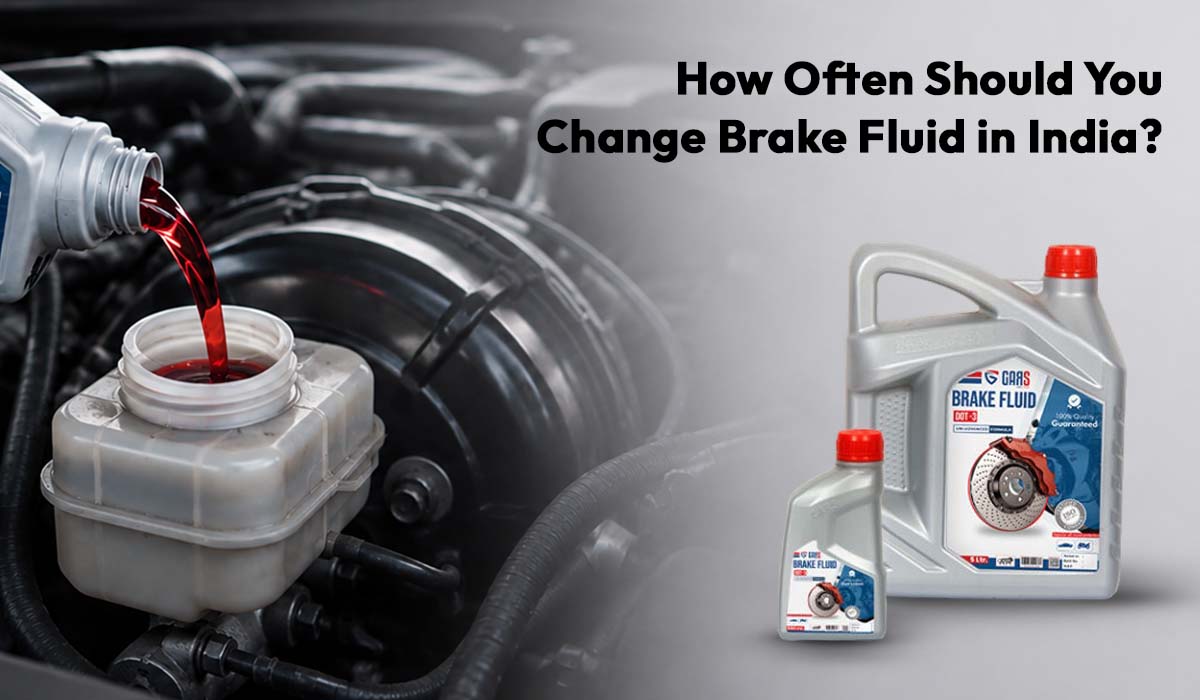
How Often Should You Change Brake Fluid in India?
How Often Should You Change Brake Fluid in India? The Answer Most Vehicle Owners Get Wrong
Here is something most Indian vehicle owners do not know - topping up brake fluid and changing brake fluid are two completely different things. Most people do the first and skip the second entirely. That gap between what people do and what their braking system actually needs is where brake failures happen.How often to change brake fluid for most vehicles in India - every 1 to 2 years or every 25,000 to 40,000 km, whichever comes first. That is the baseline. In Indian conditions - monsoon humidity, stop-start city traffic, and mountain descents - that interval matters more than it does almost anywhere else in the world.
Moisture finds its way into brake fluid through the rubber components in your brake system - slowly, invisibly, and continuously. As moisture builds up, the fluid's ability to handle heat drops - and braking generates a lot of heat. When that fluid can no longer handle the temperature, you get brake fade. In the worst cases, you get no brakes at all.
This guide covers the full brake fluid maintenance schedule by vehicle type, DOT grade, the warning signs your fluid is overdue, and why Indian road conditions specifically shorten the brake fluid lifespan India drivers should be planning around.
Why Brake Fluid Degrades Even When You Never Open the Reservoir
Brake fluid is hygroscopic - it pulls moisture from the surrounding air through the rubber hoses and seals in your brake system. You cannot stop this from happening. You can only manage it by changing the fluid on schedule.Fresh DOT 4 brake fluid has a wet boiling point of around 155°C. Once that fluid absorbs just 3% water - which can happen within a year or two of normal use - that boiling point can drop to as low as 100°C. A vehicle braking hard on a ghat road descent or sitting in Mumbai traffic with repeated braking cycles can push brake temperatures well past that point.
When brake fluid boils, it vaporises inside the lines. Vapour compresses - brake fluid does not. The pedal goes soft, stopping distance increases, and in serious cases the brakes stop responding altogether.
The catch is that this process is invisible. The fluid can look perfectly clean while being dangerously degraded. Think of it the same way you think about engine oil - you cannot judge it by looking at it. The brake fluid lifespan India conditions allow is shorter than most owners assume, which is exactly why so many brake system problems show up without warning.
Not Sure How Often Your Engine Needs an Oil Change?
Brake Fluid Change Schedule by Vehicle Type
The right brake fluid change interval in India depends on what you are driving and how you are using it:| Vehicle Type | Change Interval | DOT Grade | Special Note |
| Commuter Bikes (up to 150cc) | Every 1–2 years / 15,000 km | DOT 3 or DOT 4 | Check every monsoon season |
| Performance Bikes (150cc+) | Every 1 year / 15,000 km | DOT 4 minimum | More heat from aggressive riding |
| Hatchbacks & Sedans | Every 2 years / 40,000 km | DOT 3 or DOT 4 | Per manufacturer spec |
| SUVs with disc brakes on all 4 wheels | Every 2 years / 30,000 km | DOT 4 | Higher braking loads |
| Commercial Trucks | Every 1 year / 40,000 km | DOT 4 | High usage - inspect more often |
| Vehicles with ABS | Every 2 years | DOT 4 minimum | Never use DOT 5 in ABS systems |
Commuter Bikes - Hero Splendor, Honda Activa, TVS Jupiter:
These bikes run daily, often in heavy city traffic with repeated braking. DOT 3 or DOT 4 works for most models but check the owner manual. The brake fluid change for bikes India recommendation sits at every 1 to 2 years - do not let it slide past two monsoon seasons without a change.Performance Bikes - Royal Enfield, KTM, Bajaj Pulsar NS200:
Aggressive riding generates significantly more brake heat than commuter use. A yearly change on DOT 4 minimum is not optional for these bikes - it is what keeps the braking consistent when you actually need it.Hatchbacks and Sedans - Maruti Swift, Hyundai i20, Tata Nexon:
For the when to change brake fluid car question on standard passenger vehicles, every 2 years or 40,000 km is the baseline. Always cross-reference with your manufacturer's specification - that number takes priority.SUVs - Mahindra Scorpio, Toyota Innova, Tata Safari:
Heavier vehicles generate more heat through their brakes, particularly those with disc brakes on all four wheels. Every 2 years at 30,000 km is the practical interval for most SUVs in Indian conditions.Commercial Trucks:
High daily mileage and heavy braking loads mean annual changes at minimum. Inspect more frequently if the vehicle is running mountain routes or carrying maximum loads regularly.Brake Fluid Change Interval by DOT Grade
Not all brake fluid degrades at the same rate - the grade matters:- DOT 3 - Change every 1 year or 15,000 km. The most hygroscopic of the common grades, it absorbs moisture fastest and degrades soonest. If your vehicle specifies DOT 3, stick to the shorter end of the interval in Indian humidity.
- DOT 4 - Change every 2 years or 40,000 km. Better moisture resistance than DOT 3 and a higher boiling point. The most commonly recommended grade for modern Indian passenger vehicles and bikes.
- DOT 5 - Change every 3 years. Silicone-based and does not absorb moisture - but it is not compatible with ABS systems and cannot be mixed with DOT 3 or DOT 4. Rarely used in standard Indian vehicles.
- DOT 5.1 - Change every 2 to 3 years. High performance glycol-based fluid with excellent heat resistance. Used in performance applications where DOT 4 is not enough.
Why Indian Conditions Shorten Brake Fluid Life
This is where global recommendations and Indian reality part ways. The standard intervals assume moderate climates and consistent driving patterns. India offers neither. Monsoon Season: Ambient humidity during June to October is the single biggest accelerator of moisture absorption into brake fluid. Checking and if necessary replacing brake fluid before the monsoon arrives - around May - and inspecting it again after October is a practical schedule for brake fluid for monsoon season India conditions. This applies across the country but especially in coastal cities like Mumbai, Kochi, and Chennai. City Traffic: Stop-start driving in Delhi, Bangalore, Surat, and Mumbai generates repeated braking cycles that heat the fluid far more than highway driving at the same distance covered. The odometer reading alone does not tell the full story - how those kilometres were covered matters just as much. Ghat Roads and Hill Terrain: Descending the Western Ghats, Himachal roads, or Uttarakhand passes puts sustained heat into brakes for extended periods. This is exactly the scenario where degraded fluid with a lowered boiling point creates a real safety risk. Vehicles that regularly run these routes should be on the shorter end of every interval. Older Brake Lines: Many Indian vehicles run for 8 to 12 years without a full brake system overhaul. Older rubber brake lines allow more moisture ingress than new ones - which means the fluid inside degrades faster regardless of when it was last changed.Warning Signs Your Brake Fluid Needs Changing Now
Your vehicle will usually tell you something is wrong before a full brake failure - if you know what to look for:- Spongy or soft brake pedal - air or water vapour has entered the brake lines
- Pedal travelling closer to the floor before the vehicle stops than it used to
- Dark brown or black fluid in the reservoir - fresh fluid is clear or pale yellow
- Burning smell from the brakes after traffic driving or a descent
- ABS warning light on the dashboard - degraded fluid can trigger sensor faults
- Longer stopping distance - the vehicle takes noticeably more road to stop
For further reading on brake system issues, see our guide on what causes brake fluid to leak - a separate but related problem that affects many Indian vehicles after extended use.
How to Check Brake Fluid Condition Between Services
You do not need to visit a workshop to do a basic check:- Step 1: Find the brake fluid reservoir - on cars it sits on top of the master cylinder near the firewall. On bikes it is near the handlebars on the front brake side.
- Step 2: Check the fluid level against the MIN and MAX marks on the reservoir without opening it.
- Step 3: Look at the colour through the reservoir wall. Clear or pale yellow means the fluid is in reasonable condition. Dark brown means it is time for a change.
- Step 4: If you want a more accurate reading, brake fluid test strips are available at most auto parts shops across India. Dip one in and check the moisture or copper level reading - it gives you a clearer picture than colour alone.
Regardless of what a visual check shows, a full professional fluid flush every 2 years is the right standard to hold to.
Conclusion
For most Indian vehicles, how often to change brake fluid comes down to a simple rule - every 1 to 2 years, every monsoon season check without fail, and match the DOT grade to what your vehicle actually specifies. The brake fluid change interval in India needs to be shorter than global averages because Indian conditions - humidity, traffic heat, and ghat roads - accelerate fluid degradation faster than most standard recommendations account for.Brake fluid is one of the cheapest fluids in your vehicle to replace. A brake system failure is not.
Looking for quality Brake Oil in India? Explore the Gars brake oil range - formulated for Indian vehicle specifications and available across the country.
Are you a distributor or fleet manager? Contact us for bulk brake fluid supply.
FAQ's
Can I just top up brake fluid instead of changing it?
Topping up and changing are not the same thing. Topping up replaces volume - it does not remove the moisture-contaminated fluid already in the system. Old degraded fluid mixed with fresh fluid still degrades at the rate of the old fluid. Topping up is a short-term fix for low levels - changing is what actually maintains braking safety.How much does a brake fluid change cost in India?
Brake fluid change cost India varies by city and vehicle type but generally runs between ₹300 and ₹800 for most cars and bikes at an authorised service centre. Independent workshops may charge less. The fluid itself costs ₹150 to ₹400 for a standard 500ml bottle depending on the DOT grade and brand. It is one of the cheapest maintenance jobs on any vehicle.What happens if I never change my brake fluid?
Moisture content builds up year after year, lowering the boiling point of the fluid progressively. In normal city driving this shows up as a spongy pedal and longer stopping distances. In a hard braking situation - emergency stop, mountain descent, or heavy traffic - degraded fluid can vaporise inside the lines and cause partial or complete brake failure. The risk is real and the cost of prevention is minimal.Should I change brake fluid before or after monsoon in India?
Before, if possible. Changing the fluid in April or May gives you fresh fluid going into the highest-humidity months of the year. If you missed the pre-monsoon window, changing it in October after the rains end is the next best option. Either way, do not go through two monsoon seasons on the same fluid.Is brake fluid change included in standard car servicing in India?
Not always. Many standard service packages include a brake fluid top-up but not a full flush and change. Check specifically what your service centre is doing - ask whether they are flushing and replacing the fluid or simply topping it up. If the answer is topping up, request a full change if the fluid is due.Recent Post
Top Categories
Popular Products